

Oct 19, 2026 · @Erik Minty · Chief Simplicity Officer
At last week’s ONTABA conference in Toronto, we asked ABA practitioners two short sets of questions about AI and data: how their teams collect and use data today, and how they feel about AI entering their practice. It generated some very passionate discussions!
Side note: by “AI”, we’re technically referring to Large Language Models (LLMs) such as Claude or ChatGPT; whether these can properly be called true “Artificial Intelligence” (AI) remains a subject of debate.
Five people completed the AI questions and two completed the data-practice questions. That is a small group, so it’s best to consider it as a conversation starter rather than a benchmark. With a packed conference agenda, many survey participants provided only incomplete results. (We can talk about “cognitive load” …)
Even so, the answers we did get were interesting and worth sharing. So that’s what we’ll do. I’ve included links to related topics we’ve covered in the past in case you want to dig deeper. Enjoy!
Paper is still the backbone. Seven people answered the background questions in the AI survey. Five of them collect at least some ABA data on paper, four use spreadsheets or online documents, and two use an ABA-specific platform. Most teams mix methods. Both respondents to the data-practice survey also use paper alongside spreadsheets. Subjectively, this data aligned well with our casual notes from in-person conversations with practitioners.
Data Collection pain is during and after the session. The two data-practice respondents described their current setup as “neutral” and “dissatisfied.” Their challenges included slow or distracting data entry during sessions, graphing and progress tracking, keeping programs current across a team, training new staff, and privacy. Asked to fix one thing tomorrow, one wrote: “Post session data updates and analysis [as it] happens.”
AI use is already normal. Of the five who answered the AI questions, one uses AI tools regularly, three occasionally, and one tried it with limited success. Four described themselves as cautiously optimistic about AI in ABA practice, and one as skeptical. Using AI and endorsing it are clearly different things: the skeptic is also an occasional user.
Personal AI use isn’t leading to ABA-specific tools. Two of the five weren’t aware of any AI-based ABA platforms, two were aware but hadn’t tried one, and one had evaluated one. The most frequent AI user was among those unaware of any.
The most popular uses were about making sense of data and explaining it: spotting trends in learner data and simplifying clinical explanations for families, each chosen by 3 of 5. Running the practice ranked low. Nobody chose scheduling, translations or staff training.

One gap surprised us. Simplifying explanations for families was a top choice, yet nobody chose translation for families who speak another language. That may reflect the families these practitioners serve, or a sense that translation isn’t AI’s job. For now, we’ll chalk that question up to the small sample size and move on.
On clinical decisions, the group wants AI as an advisor. When asked how much AI involvement is appropriate for decisions like changing a target or protocol, 4 of 5 chose “AI advises, human decides.” The fifth chose “AI acts, human reviews changes after,” but also required human clinical review before anything is saved. Those two answers suggest terms like “agentic” may mean different things to different people.
Each role drew the line around its own core work. We asked what AI should never do. The two front-line practitioners (RBTs) both named working directly with clients. The two clinical supervisors (BCBAs / RBAs) named clinical judgment and assessing the function of behaviour. With two people per role this is thin data but still hints at a pattern: it suggests that people resist AI most where it would touch the part of the job that defines their role.

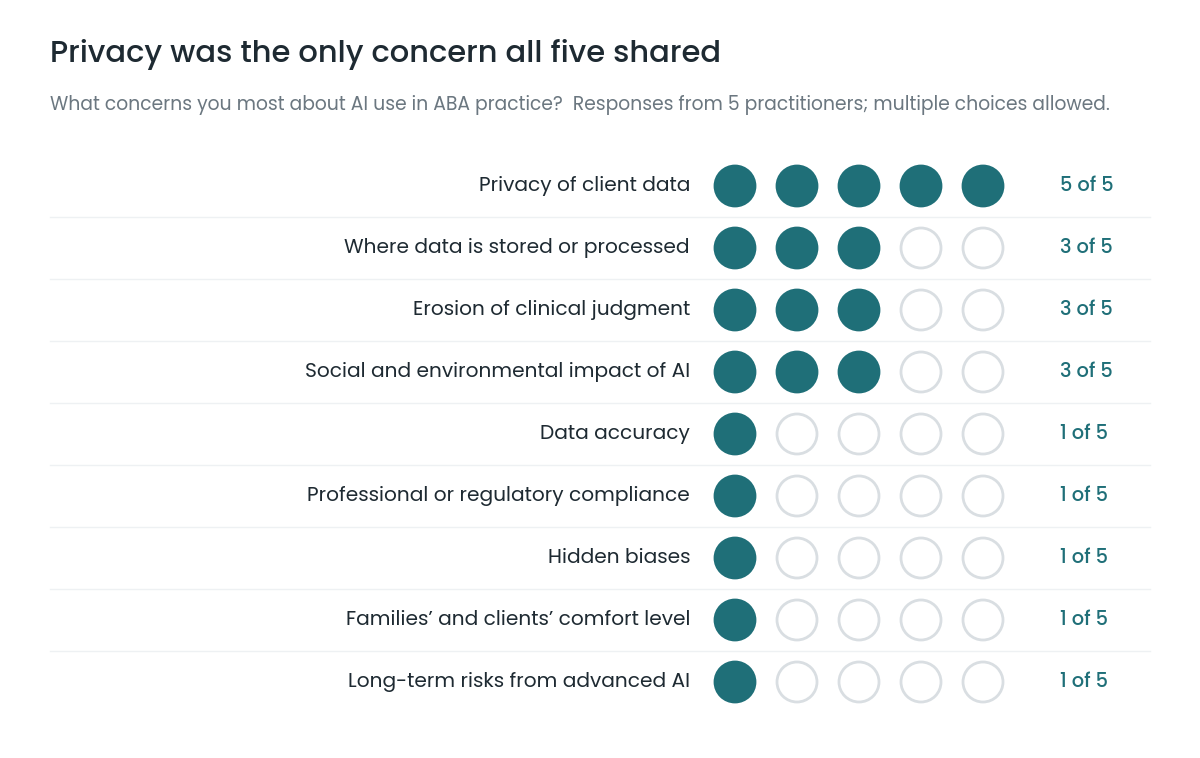
Privacy of client data was the only concern all five shared. Three concerns tied for second: where data is stored or processed, erosion of clinical judgment, and the social and environmental impact of AI.
Supervisors and front-line staff worried about different things. Both clinical supervisors flagged erosion of clinical judgment, and neither flagged where data is stored. Both front-line practitioners flagged data storage and data residency. Again, it’s a small sample set. But it lines up with the “never” answers above: each role guards the part of the work they are closest to.
Environmental impact came up more than we expected. Three of five named the social and environmental impact of AI as a concern. Asked what they’d like AI to do, one respondent answered simply: “Reduce environmental impact.” This rarely appears in conversations about AI in clinical practice, but it’s clearly a concern. Further discussion needed perhaps?
Trust rests on proof and a human gate. The two most common requirements were evidence that the data is accurate and human clinical review before anything is saved. Features that explain how AI works, such as audit trails and explanations of results, were each chosen by only one person.

Experience seems to sharpen the questions people ask. The one respondent who had evaluated an AI-based ABA platform reported limited success with AI. They were also the only one to name data accuracy as a concern and the only one to require an audit trail. That is one person’s experience, but it does connect some curious dots.
The uses practitioners wanted most from AI, such as spotting trends and summarizing progress, need data that is digital, structured and current. Yet most survey participants still collect at least some data on paper. In their own words, they want AI to “help pull trends and summarize data” and to “analyze behavioural data.”
The data-practice survey tells a similar story. The pain points there were graphing, progress tracking and analysis after the session. For many teams, the real obstacle may come before AI enters the picture: getting session data into a form that anyone, or anything, can analyze.
There is a second side to this. Paper is also (in theory) the most private format, at least assuming it never leaves the room. The data concerns respondents raised about AI, namely privacy, data storage location and data residency, apply just as much to digitizing data in the first place. Moving off paper means answering those questions too, whether or not AI is ever involved.
These are the open-ended answers, unattributed:
One thing I’d like AI to do in my practice:
- “Help pull trends and summarize data.”
- “Analyze behavioural data.”
- “EDI practices based on the client’s profile. Are there specific factors we need to be aware of before interacting with the client?”
- “Reduce environmental impact.”
One thing I’d never want AI to do:
- “Work directly with clients.”
- “Clinical judgment.”
- “Assess functions of behaviour.”
One thing I’d fix tomorrow about our data system:
- “Post session data updates and analysis [as it] happens.”
OK, yes – this was a small survey size, so it begs more questions than it answers. Here are some follow-on questions that come to mind, worth noodling over more:
We ran two short, anonymous, opt-in surveys at the ONTABA Conference in October 2026: one on ABA data practices and one on AI in ABA practice. The AI survey had 13 starts. Seven people answered the background questions and five completed the AI questions (two BCBAs, two RBTs and one school-based educator). The data-practice survey had four starts, and two people answered most questions. Its later sections, on scheduling, funding and connected systems, received no answers and are not reported.
The two surveys were independent, and we can’t tell who answered both. So we report each survey’s numbers separately and never add them together. Most questions allowed multiple answers, so counts don’t sum to the number of respondents. Open-ended answers are unattributed, and some role descriptions have been generalized to protect respondents’ anonymity.
